Hello World!
HYBRID VS CONVENTIONAL RESIN TYPES: A NEW ERA IN FOUNDRY BINDER TECHNOLOGY.
The foundry industry has relied on resin-based binders for decades, with conventional furan systems forming the backbone of no-bake casting.
But as demands for sustainability, efficiency, and high-quality output grow, these traditional systems are facing scrutiny. This is where hybrid resins,
such as the Kaltharz 8500 family, step in—offering a modern alternative designed to overcome the limitations of older technologies.
Conventional Resin Systems: Strengths and Limitations.
Conventional furan-based no-bake binders have been valued for their reliability and productivity. High furfuryl alcohol content (85–90%)
traditionally equated to high-quality molds and castings. However, the reliance on strong acid activators brings challenges:
-
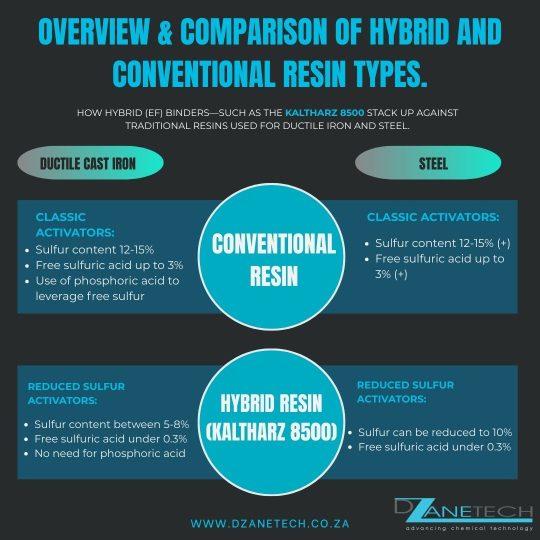
High sulfur content (12–15%)
-
Free sulfuric acid levels up to 3%
-
Use of phosphoric acid to stabilize performance
-
Elevated emissions and workplace exposure risks
-
Greater potential for graphite degeneration in ductile iron
While effective in delivering strong curing, these systems often require expensive protective measures and careful management
of environmental impacts.
The Hybrid Advantage.
Hybrid resins represent a step-change in binder technology. By incorporating a specially modified FA-phenolic polymer
(Hybrid FR/PR, or PRFuran), curing power shifts from the activator to the resin itself. This subtle but powerful change
leads to major benefits:
-
Reduced sulfur activators: down to 5–8%, with free sulfuric acid below 0.3%
-
No need for phosphoric acid
-
Lower emissions across the entire manufacturing process
-
Better compatibility with regenerated sand
-
Improved mechanical strength and resistance to hot cracking in steel and ductile iron
Essentially, hybrids achieve the same—or better—performance than conventional binders while being safer,
cleaner, and more adaptable.
Side-by-Side Comparison.
Real-World Impact.
Case studies across nodular cast iron, ductile iron, and steel confirm the advantages of hybrids.
Foundries using Kaltharz 8500 report lower resin consumption, better sand recovery cycles,
and superior casting surfaces—all while reducing environmental impact and material costs.
The transition from conventional to hybrid resins marks more than an incremental improvement—
it represents a fundamental evolution in binder technology. With lower emissions, reduced reliance
on harsh acids, and improved casting quality, hybrid systems like Kaltharz 8500 are redefining what’s
possible in foundry operations.
As the industry continues to prioritize sustainability and performance, hybrids are not just the future—
they are the new standard.